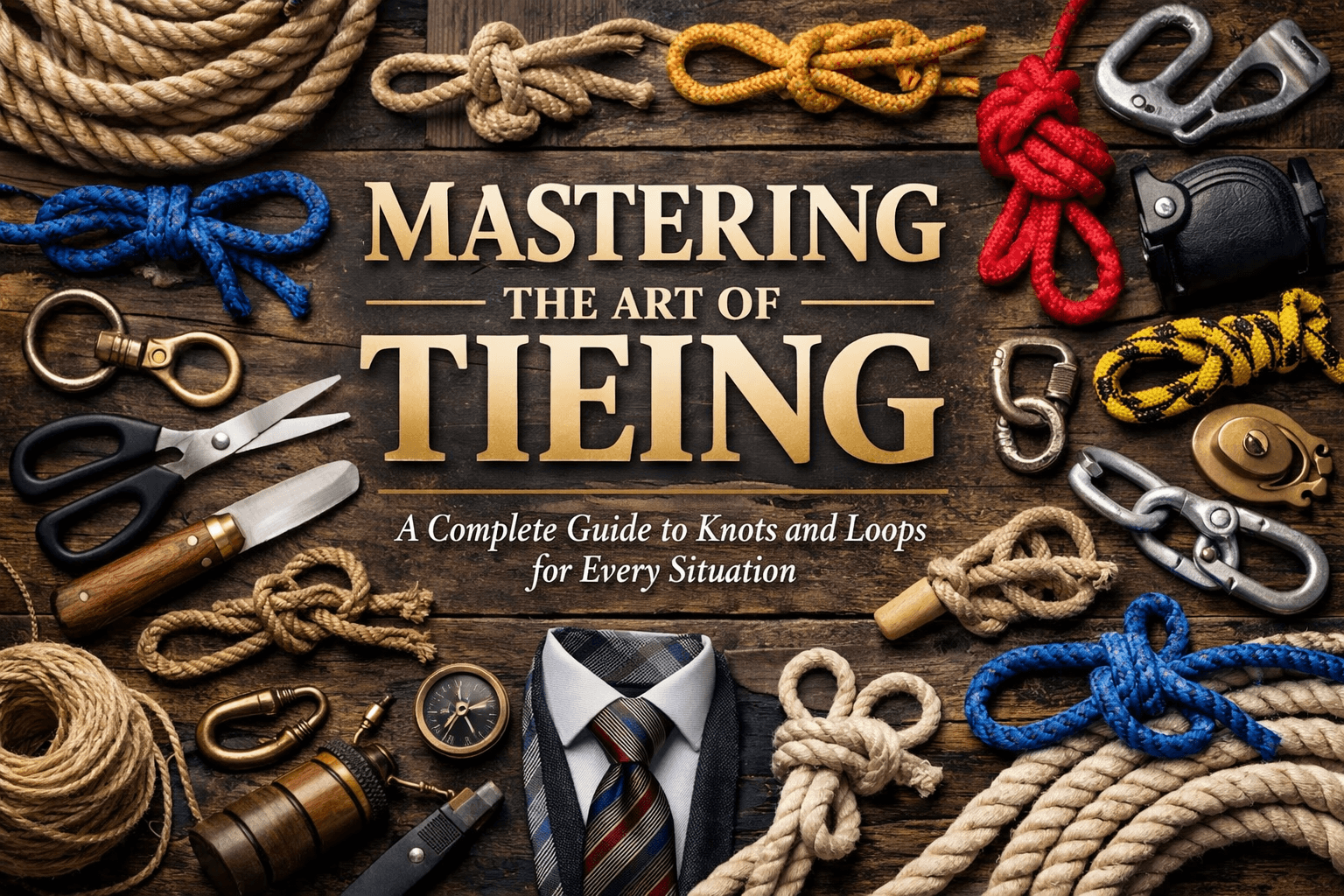
Tieing
The Ultimate Guide to Mastering the Art of Tieing Anything with Confidence
Have you ever found yourself struggling with a piece of string or a long rope, wondering how to make it stay put? You are not alone! The simple act of tieing is one of the most important skills a human can learn. It is more than just making a knot; it is about creating safety, building useful tools, and even expressing your personal style. Whether you are securing a load on your truck, setting up a cozy tent in the woods, or just making sure your shoes do not come undone, knowing the right way to loop and pull is a total game-changer for your daily life.
In this deep dive, we are going to explore the wonderful world of knots. We will look at how this ancient skill helps your brain stay sharp and your hands stay strong. You do not need to be a sailor or a mountain climber to benefit from these tricks. From the basics of a simple overhand knot to the clever loops used by professionals, we have got you covered. Get ready to transform from someone who just “makes a mess with string” into a master of the craft. Let’s pull those loose ends together and get started on this exciting journey of discovery and practical magic!
Why Learning Different Tying Techniques Matters for Your Brain and Body
When you practice tieing different types of knots, you are actually giving your brain a fantastic workout. It requires a lot of focus to follow the loops and turns needed to get a knot just right. This process helps improve your “spatial awareness,” which is just a fancy way of saying you understand how objects move in space. For kids and adults alike, this is a wonderful way to build patience. You might not get it right the first time, but that feeling of success when the knot finally clicks into place is absolutely worth the effort.
Beyond the mental perks, your hands get a great workout too! Manipulating thin cords or thick ropes improves your fine motor skills. This means your fingers become more nimble and your grip becomes stronger. People who practice these skills often find they are better at other tasks, like writing by hand or fixing small things around the house. It is amazing how a simple piece of rope can become a tool for self-improvement. By learning these methods, you are building a “toolbox” of skills that will stay with you forever, no matter where you go.
The Anatomy of a Knot: Understanding the Lingo Before You Start
Before we dive into the specific steps, we need to speak the same language. Every rope has parts that experts use to describe how to move it. The “working end” is the part of the rope you are actively moving around to create the knot. Think of it as the lead actor in a play. The “standing part” is the rest of the rope that just stays still. When you fold the rope to make a “U” shape, that is called a “bight.” These small terms make it much easier to follow instructions without getting your fingers in a tangle.
Knowing these words helps you follow along with any guide you find. If someone tells you to “pass the working end through the bight,” you will know exactly what to do! It turns a confusing mess of string into a clear set of steps. This foundation is what separates a beginner from someone who truly understands the craft. Once you have the vocabulary down, you can start exploring more complex structures. It is like learning the alphabet before you start writing a story. Soon, you will be tieing loops that look like professional work.
Essential Tying Methods Every Homeowner and Adventurer Should Know
There are thousands of knots out there, but you only need a handful to handle 90% of life’s challenges. The “Square Knot” is the king of joining two ropes together. It is simple, flat, and very strong. If you are camping, the “Clove Hitch” is your best friend for attaching a rope to a tree or a post. It is incredibly fast to create and stays tight under pressure. For those who love the water, the “Bowline” is a must-learn. It creates a fixed loop that will never slip, which is why people call it the “king of knots.”
Using these methods in your daily life makes things so much easier. Imagine being able to secure a Christmas tree to the roof of your car without worrying about it sliding off. Or think about how helpful it is to tie a secure line for drying clothes in your backyard. Each of these situations requires a specific type of hold. When you choose the right one, you save time and keep your belongings safe. Tieing things correctly isn’t just about being neat; it’s about being effective and smart with the resources you have at hand.
Step-by-Step Table: The Most Popular Knots and Their Best Uses
| Knot Name | Primary Use | Difficulty Level | Why It’s Great |
| Square Knot | Joining two ropes of equal thickness | Very Easy | Lays flat and doesn’t bulk up. |
| Bowline | Creating a fixed loop at the end of a rope | Medium | Won’t slip or jam under a heavy load. |
| Clove Hitch | Securing a rope to a pole or tree | Easy | Very fast to tie and easy to adjust. |
| Sheet Bend | Joining two ropes of different sizes | Medium | The only reliable way to connect thick and thin ropes. |
| Taut-Line Hitch | Creating a sliding loop for tension | Hard | Perfect for tightening tent lines or clotheslines. |
| Figure Eight | A “stopper” knot to prevent slipping | Easy | Very easy to see if it is tied correctly. |
Mastering the Bowline: The Lifesaving Loop for Every Occasion
The Bowline is often the first “real” knot people learn because it is so useful. It creates a loop that stays the same size, no matter how hard you pull on it. This makes it perfect for rescue situations or for securing a boat to a dock. A great way to remember how to tie it is the “Rabbit and the Hole” story. You make a loop (the hole), the end of the rope (the rabbit) comes up through the hole, goes around the tree (the standing part), and jumps back down into the hole. It is a fun way to learn!
Once you master this, you will find yourself tieing bowlines for everything. It is great for hanging a bird feeder or even making a temporary handle for a heavy bag. The best part is that even after it has held a lot of weight, it is still very easy to untie. Some knots “jam” and become impossible to get loose, but the bowline is always friendly. It is a reliable partner for any task. Practice it while you are sitting on the couch watching TV, and soon your hands will do it without you even thinking about it.
Creative Ways to Use Tying Skills in Your Home Decor
Who says knots are just for the outdoors? You can bring the art of tieing inside to make your home look beautiful. Macramé is a popular style of art that uses different knots to create wall hangings, plant holders, and even curtains. By using soft cotton cords, you can turn simple loops into intricate patterns. It is a very relaxing hobby that allows you to be creative while using the same skills you would use in a survival situation. It’s the perfect blend of being tough and being artistic at the same time.
You can also use these skills for practical home fixes. Use a “Timber Hitch” to bundle up old newspapers or firewood for the fireplace. Use a “Slippery Hitch” to tie back curtains so they stay open during the day but can be released with a single pull. These small touches make your home function better and show off your expertise. Plus, when guests see your perfectly tied bundles or beautiful handmade decor, they will definitely be impressed. It’s a great way to show that you care about the little details that make a house a home.
Safety First: What to Avoid When Securing Heavy Loads
While tieing is a superpower, you have to use it correctly to stay safe. One of the biggest mistakes people make is using a “Granny Knot” when they think they are making a Square Knot. A Granny Knot is unstable and can slip at the worst possible moment. Always double-check your work! If a knot looks messy or “lumpy,” it is probably wrong. A good knot should look symmetrical and neat. This “clean” look is actually what makes the knot strong because the friction is distributed evenly across the rope.
Another safety tip is to check the condition of your rope. No matter how good your tieing skills are, a rotten or frayed rope will eventually break. If you are securing something heavy on a vehicle, always use more than one line. This creates a backup system just in case one part fails. Also, remember that some synthetic ropes are very slippery. For these materials, you might need to add an extra “turn” or a “stopper knot” to make sure everything stays put. Safety isn’t just a habit; it’s a mindset that keeps you and everyone around you out of harm’s way.
Teaching the Next Generation: How to Make Tying Fun for Kids
Passing on the skill of tieing to children is a gift that lasts a lifetime. Instead of making it a boring chore, turn it into a game! Use colorful ropes or even licorice strings to make it delicious. You can tell stories about sailors on the high seas or explorers in the jungle who used these exact same loops to survive. When a child successfully ties their own shoes or helps set up a backyard tent, their confidence sky-rockets. They feel like they can handle the world because they have mastered a real-world tool.
Start with very simple tasks. The “Overhand Knot” is the perfect place to begin. Once they get that down, move on to the “Slip Knot,” which is like a magic trick because it disappears when you pull it. This “magic” keeps them engaged and wanting to learn more. By the time they are teenagers, they will be the ones helping their friends secure gear for a camping trip. You aren’t just teaching them how to move string; you are teaching them logic, coordination, and the importance of being prepared for anything.
The Science of Friction: Why Knots Actually Stay Together
It might seem like magic, but tieing is actually all about physics. When you loop a rope around itself, you are creating friction. The more times the rope crosses over or under itself, the more friction is generated. When you pull on the ends, the rope actually squeezes itself tighter! This is why a well-tied knot gets stronger as you add weight to it. Understanding this helps you realize why “stuffing” a knot doesn’t work. You need the right pattern to let the physics do the heavy lifting for you.
Different materials have different “coefficients of friction.” This is just a way of saying some ropes are grippier than others. Cotton and hemp are very grippy, while nylon can be quite slick. When you are tieing a knot in a slick rope, you often have to use a more complex version of the knot to make sure it holds. This is why experts choose their ropes carefully based on what they need to do. It is a fascinating mix of science and hands-on skill that has helped humans build civilizations for thousands of years.
Conclusion: Tighten Your Skills and Take Control of Your World
In the end, the art of tieing is one of the most empowering skills you can own. It connects us to our ancestors who used vines to build shelters and reminds us that we don’t always need high-tech gadgets to solve problems. By spending just a few minutes a day practicing these loops and hitches, you become more capable, more confident, and more useful in any situation. Whether you are at home, in the garden, or out on a grand adventure, your knots will be there to hold everything together.
So, go grab a piece of scrap rope and start practicing today! Challenge yourself to learn one new knot every week. Before you know it, you will be the person everyone turns to when something needs to be secured. You have the power to create strength out of nothing but a simple cord. It is a quiet, steady kind of mastery that brings a deep sense of satisfaction. Keep pulling, keep looping, and keep growing. Your journey into the world of knots has only just begun, and the possibilities are endless!
Frequently Asked Questions About Tying
1. What is the easiest knot for a beginner to learn?
The “Overhand Knot” is the simplest one. It is the basic “loop and pull” that most people use as a starting point for almost every other knot. It is perfect for preventing a rope from fraying at the end.
2. Can I use the same knot for every type of rope?
Not exactly. While many knots work on various materials, some slippery synthetic ropes (like nylon) require extra turns to stay secure. Always test your knot before putting it under a heavy load.
3. Why does my knot always get stuck and won’t untie?
This is called “jamming.” Some knots, like the overhand, are prone to this. To avoid it, use knots like the “Bowline” or “Figure Eight,” which are designed to be easily undone even after supporting weight.
4. How can I make my knots look more professional?
The secret is “dressing” the knot. This means pulling each part of the knot individually to make sure it is neat and the loops are laying flat before you give it a final tighten.
5. Is it better to use thick or thin rope for practice?
Medium-thickness rope (about the size of a clothesline) is best for beginners. It is easy to see the patterns you are creating, and it isn’t too fiddly for your fingers to handle.
6. Are there any apps that can help me learn to tie?
Yes! There are many great mobile apps that show 3D animations of knots being tied. These are excellent because you can rotate the view to see exactly where each part of the rope goes.
You may also like to read: Is Taylor Swift Engaged? Everything About Her 2026 Wedding & Ring!
About the Author
